Tuesday, June 15, 2010

Cosmic / Frank Cottrell Boyce


Cosmic is 13 year old Liam’s favourite saying. Liam is also very tall, he has more facial hair than a 13 year old should have and he is in the Gifted and Talented class at school. Liam is, therefore, regularly mistaken for an adult and is constantly being told that he should “know better” when he acts like a 13 year old! Frank Cottrell Boyce has weaved an entertaining story out what happens when Liam decides to start acting like a grown-up to get some of the things he wants like entrance to a contest that could win him a free trip to a new theme park with rides that are “out of this world.”

Cosmic puts Liam in a situation that every teenager wants yet despises at the same time. To be treated like a grown up seems to some teens to be the answer to all of there annoying problems. As Liam finds out there is a lot to learn about being an adult, and one of those things is how to deal with teenagers. I like this book, because of the mixture of humour, drama and life lessons it presents to young adults and yet

Boyce, Frank Cottrell (2008). Cosmic. London: MacMillan Children’s Books.

Thursday, May 27, 2010

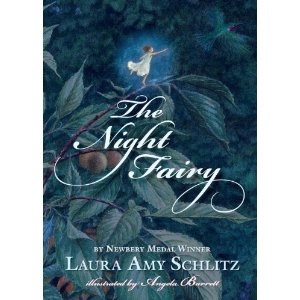
The Night Fairy / Laura Amy Schlitz and Angela Barrett (ill.)


The Night Fairy by Laura Amy Schlitz is the story of a young night fairy named Flory who lost her wings and managed to live in among animals of the woods without the confidence of being able to simply fly away to safety. Flory has to befriend a squirrel named Skuggle in order to get food and to stay safe from the dangerous creatures and the giantess that roams this part of her world. Flory hatches a plan to ride on the back of a hummingbird in order to gain some of the freedom she had when she could fly, if she could only get the attention of the bird and convince it to do something it really does not want to do.

The Night Fairy is a modern day fairy tale that tells of the struggles of Flory and her attempts to convince animals in her surroundings to help her or at least not to eat her. Flory undergoes many emotional moments as she makes some hard decisions about her predicament and the path she should follow. The Night Fairy is beautifully, but sparsely illustrated by Angela Barrett and the story is clearly enhanced by the visual clues she adds to the story.

Schlitz, Laura Amy and Angela Barrett (illustrator) (2010). The Night Fairy. Somerville, MA: Candlewick Press.

Wednesday, April 21, 2010

Skellig / David Almond


Skellig is another tale by David Almond that combines the real-life drama of a ten year old boy’s life with a mysterious creature that lives in his garage. Michael has just moved into a new house with his mother and father and his ailing infant sister. Michael sneaks into the garage that should be condemned only to find an old “man” or “creature” living behind some furniture surviving on bugs and mice and crippled to the point that he cannot move. Michael helps the cranky creature and with the help of his new friend Mina moves Skellig from the dangerous structure only to discover that the he is transforming from a crippled wisp of man into something very different.

Skellig looks at various questions that a ten year old boy might have like; how can he help his family through a painful event like having a sick baby, are there such things as angels and how would we know if we saw one. Michael also has to navigate the sea of friendships to see if he can trust new friends and if he should ignore old friends. Michael also has to sail through the waves of adults that continue to draw his attention away from his curiosity about Skellig and his love for his sister.

Almond, David (1998). Skellig. New York: Yearling Book.

Wednesday, March 3, 2010

Godless / Pete Hautman


Godless by Pete Hautman is the story of Jason, a teenager and his friends and their flirtations with creating a new religion. Much of the impetus for this action is Jason’s feeling that his father is forcing his Christian vies on Jason. With his sharp wit, his acid tongue and his vivid imagination, Jason creates a new religion called /Chutengodism, which is based on worshipping the local 10 legged water tower. Jason’s ne religion draws in some curious, obsessive and troublesome friends. The results of this adventure are surprising, exciting and at times scary.

Godless portrays a type of teen rebellion that I’m sure many teens have felt and reacted to in their own unique way. Jason gives voice to this rebellion making some good points along the way yet finding that being a leader is fraught with difficulties. This story does not in the end make any moral or philosophical conclusions about the existence of a God or gods, but it does examining the issues from the perspective of a boy who will not be told how he should think or believe on the topic of religion.

Hautman, Pete (2004). Godless. Toronto: Simon Pulse.

Friday, January 22, 2010

Food, girls and other things I can’t have / Allen Zadoff


Food, girls and other things I can’t have is a thoughtful book about Andrew the second fattest boy in his sophomore year at high school. Andrew begins this book worrying about his weight, his status in school and the girl he has fallen for at the end of summer vacation. Andrew completely embarrasses himself (and injures several classmates) while trying to impress April on the soccer field. Andrew is then mysteriously rescued from the school bully by the school’s top jock. Andrew is recruited onto the football team and leaves his friends and the model UN behind. Andrew then spends a turbulent few weeks trying to hide the fact that he is playing football from his mother and at the same time trying to navigate his quickly rising school status and the mystery of why he has become so popular all of a sudden.

Food, girls and other things I can’t have gives the reader an inside look of what it is like to be fat in high school and many of the social and psychological implications of it. Andrew is continuously tormented by thoughts of weather people are making fun of him or if they are trying to use him in some way and he also has to decide which group of friends he wants to hang out with and who to trust as his after school activities change.

Allen Zadoff (2009) Food, girls and other things I can’t have, New York: Egmont.

The “Go Ask Alice” book of answers: A guide to good physical, sexual, and emotional health / Columbia University’s Health Education Program


The “Go Ask Alice” book of answers is an incredible resource of health information for young adults. The book is produced by Columbia University’s Health Education Program essentially for the students of that institution, but it has achieved a much wider audience, because of the accuracy and honesty of its content. The book evolved from the website that started in 1993 and is still answering questions for young adults on topics such as: masturbation, orgasms, contraception, STD’s, emotional health, fitness, nutrition drugs and alcohol, relationships, men’s, women’s and general health questions. The questions are as frank and explicit as the answers are and readers are left with high quality information, advice and references for further research.

“Go Ask Alice” is, I feel an invaluable resource for older teens and young adults that either have trouble talking to their parents about these personal and sometimes intimate topics. The book and website are also important to those readers that have no other source of information on these topics than friend’s gossip and urban legends. This resource does not shy away from the controversial in that it addresses questions such as can men be pressured to have sex, date rape drugs and questions for the GLB and Q community.

Columbia University’s Health Education Program (1998) The “Go Ask Alice” book of answers: A guide to good physical, sexual, and emotional health, New York: Henry Holt.

Thursday, December 10, 2009

Buddha Boy / Kathe Koja


Budda Boy by Kathe Koja is story about a persecuted new boy is school who does not fit into any of the established clichés. Martin has saved his head and goes around begging for lunch money and is mercilessly picked on by everyone and especially the cool kids. Justin gets partnered with Martin on an economics project and becomes the only one in school to befriend him. Justin finds out the Martin’s spiritual name is Jinsen and that he is also an incredible artist. Justin has a soft spot for artists, because his father is also an artist and he is very close to his father.

Budda Boy is a powerful novel about bullying, tolerance, self-discipline, religion, and friendship. Narrated from Justin’s point of view the listener gets a vivid sense of strong emotions that teenagers have regarding their friends, fairness and how much pressure they undergo to fit in to the established norms. Jinsen shows great self control in his determination to follow his Buddhist teachings and undergoes humiliation and physical abuse for it, but he also ends up influencing almost everyone in school for the better because of his attitude and his great artistic talent.

Koja, Kathe (Author), & Murphy, Spencer (Narrator). (2003). Buddha Boy [Sound recording]. [Syracuse, NY]: Full Cast Audio.