Showing posts with label fiction. Show all posts

Monday, August 15, 2011

The Book Thief by Markus Zusak


The Book Thief is a story of a young girl named Liesel and her life in Nazi Germany during World War II. Liesel is adopted by Hans and Rosa as economic conditions deteriorate, political and social tensions heighten and the war approaches. The setting is one ripe with drama and apprehension with all of the secrets that one has to keep, and the appearance one has to present in public in such a setting. The Book Thief not only has to deal with the difficulties of life in a fascist state, but also life in a impoverished neighbourhood – as if the life of a teenager is not hard enough to deal with on its own.

Zusak, Markus (2007) The Book Thief, New York; Knopf.

The Book Thief is not all dark and despairing, for it displays the humanity and dignity that some adults and teenagers can display in such adverse conditions. The Book Thief is a book about life and death, love and friendship, hope and dreams and yes – theft. Markus Zusak weaves these elements together in a masterful way, to create a story and a book that I highly recommend.

Monday, November 22, 2010

Monster / Walter Dean Meyers


Steve Harmon is a 16 year old boy on trial for murder. Monster is Steve’s story as he imagines it might be as a movie script with some journal entries interspersed throughout. Steve is stunned and frightened by his predicament, because he is not sure how he came to be in the jail cell and court room where he now spends his time. He is extremely afraid that he will be found guiltly and be sentenced to life in prison or the death penalty. Steve is an avid movie maker and maintains his sanity by thing about his pridicament as a movie script. He maintains his composure this way until something happens like the prosecuter calling him monster

Authour Walter Dean Meyer tells a simple but gripping tale with Steve Harmon’s trial and shows all of the raw emotions that Steve feels as the witnesses give their testimony. Steve goes through bouts of depression as witnesses testify and he wonders if it is possible for the jury to believe the various stories told about him. This is an intense story, told in a compelling way, about a gruesome act which in a highly effective manner. Messages in this book range from; choose your friends wisely and don’t make trouble to life is unfair and can you never considered not guilty.

Myers, Walter Dean (1999). Monster. New York: HarperCollins Publishers.

Thursday, September 23, 2010

Death in the Air / Shane Peacock


Death in the Air is story tale of a young Sherlock Holmes on his second case. Sherlock witnesses the fall of a trapeze artist in the very first paragraph of this mystery. Noticing some irregularities with the victim’s equipment Shelock begins an investigation to find out who would want to kill this daring acrobat and why. Shelrock finds himself embroiled in not only murder attempt, but a robbery and a race to save his mentor from lossing his home. Sherlock risks his life on many occassions to uncover evidence in this case, even though he ends physically or emotionally bruised.

Author Shane Peacock tells a riviting tale while at the same time developing the character we all know as Sherlock Holmes into the master dectective that Sir Arthur Conan Doyle created over 120 years ago. Peacock gives Holmes life as we see him struggle at developing his relationships with his mentor, his competators, his rivals and his love interest. We also learn about Holme’s great determinination to learn new skills that he will reqire to, become the best dectective in London and to achieve his ultimate goal - to rid the city of its criminal element.

Peacock, Shane (2009). Death in the Air: The boy Sherlock Holmes ; his 2nd case. Toronto: Tundra Books.

Friday, September 10, 2010

Valley of Death / Gloria Shurzynski & Alane Ferguson


Valley of Death is a page turner for teens. Olivia Landon gets more than the working vacation she bargins for when her daughter is mistaken for the Landon’s new foster child Leesa and is kidknapped. Olivia (a wildlife veteraniarian) has come to Death Valley National Park to find out why the park’s mountain goats are mysteriously dying when her family becomes embroiled in a dramatic hostage taking and standoff complete with helicopters, SWAT teams and automatic weapons. The story is told from the perspective of Jack Landon the 13 year old son of the Landons who has a hard time resisting becoming directly involved is the mission to rescue Ashley his 11 year old sister.

Authours Schurzynski and Ferguson provide a nice mix of the history and biology of Death Valley Naitonal Park in this mystery/thriller while also building a picture of a normal family that generously provides support for foster children in need. Leesa, however, is a mystery to Jack and Ashley, because their parents have not given them much information about her and she is not talking. The story is about a family that sometimes lives on the road which leads to an interesting lifestyle for their children who seem thrive on it and lead a relativelly normal life.

Shurzynski, Gloria & Ferguson, Alane (2008). Valley of death: a mystery in Death Valley National Park. Washington, D.C.: National Geographic Society.

Keturah & Lord Death / Martine Leavitt


Keturah & Lord Death is the tale of a young lady who gets lost in the woods for several days and meets Lord Death. Instead of taking Keturah the story teller to her inevitable conclusion, the handsom Lord Death falls in love with the charming girl and gives her a reprieve in exchange for a story. Lord Death allows Keturah to survive one more day in order to find her one true love and if she does she will survive her brush with Death. With the help of her friends and the magic of a local witch, Keturah scours the town in search of her one true love.

The story is in the form of a legend or fairy tale, but it deals with issues of love, death and friendship so it is appropriately classed as a young adult story. Martine Leavitt writes a complelling tale that questions what true love is and how frightenly attrachive death can appear The story may be more attractive to girls than it is to boys, but it is well written, dramatic and it has you guessing how it will end up to the last page.

Leavitt, Martine (2006). Keturah & Lord Death. Calgary: Red Deer Press.

Wednesday, August 4, 2010

Death and the Arrow / Chris Priestley


Death and the Arrow is a murder mystery set in 1715 London. Tom Marlowe is the 15 year old son of a printer befriends a young pickpocket named Will Piggot. Will is brutally murdered setting Tom on a mission to find the killer. Tom teams up with Dr. Harker, a friend of his father and they piece together clues to the mystery of various murders around the city with which Will was apparently involved. Each of the murder victims are found with Death and the Arrow cards on them and most have been shot with an arrow. And how do Mohocks fit into this story?

The London of 1715 is dark, dusty, crowded and rough. Schools are not a factor in Tom’s life, but his apprenticeship with his father as a printer has him delivering pamphlets all over the city. Tom has to be careful not to go down the wrong street or he would be in immediate danger. Chris Priestley the author describes a vivid picture of London in the early modern era and the difficulties it held for young people. Girlfriends and being popular are not so important in these times, but friendships and survival have great meaning.

Priestly, Chris (2006). Death and the Arrow. London: Corgi Books.

Tuesday, July 27, 2010

Death By Eggplant / Susan Heyboer O'Keefe


Death By Eggplant is the story of Bertram Hooks, a boy in grade eight with more than his share of problems. First of all, he is failing math and he has a bully in his class who mercilessly teases him. Thirdly, he really likes a girl in his class, but he doesn’t have the nerve to tell her and finally he wants to become a master chef, rather than an accountant like his father. Bertie can’t tell anyone about his secret cooking desire because he is sure no one would understand and he would be crucified by Dekker, the bully. When he is given a chance to pick up extra marks for math class he finds he has to care for a flour sack like a baby and things really get complicated, with his “crazy” mother, the girl he likes, Dekker who unfortunately gets a flour baby too, and Bertie’s secret desire to make muffins out of his baby.

Death By Eggplant is a fun book which weaves Bertie’s predicament into a good story which sounds realistic although highly unlikely. The author gives the main character several issues that he feels he has to solve by himself, but his main problem is simply telling other people about his troubles. If he did confide in someone, they might be able to help him with most of his problems.

O’Keefe, Susan Heyboer (2004). Death by Eggplant. New York: Roaring Brook Press.

Life of Pi / Yann Martel


Life of Pi is the story…no I should explain it as an adventure of a young Indian boy who finds himself moving from India to Canada with a ship load of his father’s zoo animals. Pi has an unusual interest in religion to the point that he starts practicing Hinduism, Christianity and the Muslim faith. This is not the most extraordinary thing about Pi’s life. When the ship travelling across the pacific with zoo animals and Pi’s family is midway between India and Midway it sinks with almost all hands lost except Pi and several zoo animals that end up in the life boat with Pi, including a 300 pound Bengal Tiger. The remainder of the book is about the 227 days that Pi survives on the pacific with the tiger.

Yann Martel weaves an incredible tale of Pi’s adventure of not only surviving two thirds of a year alone on a lifeboat in the pacific and the outstanding metal torment that entails, but he also explores the metal and emotional survival skills that one needs to survive such a situation. Martel examines Pi’s thoughts as he attempts to overcome the pain of the loss of his family, the cool headedness one needs to find food and resources to survive in a lifeboat for so long and the logic and intelligence needed to live with a Bengal Tiger only a few feet away. Some may not consider this a book for young adults, but I feel it is not too difficult for well read young people who don’t mind a good story.

Martel, Yann (2001). Life of Pi. Canada: Knopf.

Tuesday, June 15, 2010

Cosmic / Frank Cottrell Boyce


Cosmic is 13 year old Liam’s favourite saying. Liam is also very tall, he has more facial hair than a 13 year old should have and he is in the Gifted and Talented class at school. Liam is, therefore, regularly mistaken for an adult and is constantly being told that he should “know better” when he acts like a 13 year old! Frank Cottrell Boyce has weaved an entertaining story out what happens when Liam decides to start acting like a grown-up to get some of the things he wants like entrance to a contest that could win him a free trip to a new theme park with rides that are “out of this world.”

Cosmic puts Liam in a situation that every teenager wants yet despises at the same time. To be treated like a grown up seems to some teens to be the answer to all of there annoying problems. As Liam finds out there is a lot to learn about being an adult, and one of those things is how to deal with teenagers. I like this book, because of the mixture of humour, drama and life lessons it presents to young adults and yet

Boyce, Frank Cottrell (2008). Cosmic. London: MacMillan Children’s Books.

Thursday, May 27, 2010

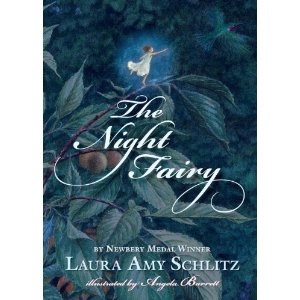
The Night Fairy / Laura Amy Schlitz and Angela Barrett (ill.)


The Night Fairy by Laura Amy Schlitz is the story of a young night fairy named Flory who lost her wings and managed to live in among animals of the woods without the confidence of being able to simply fly away to safety. Flory has to befriend a squirrel named Skuggle in order to get food and to stay safe from the dangerous creatures and the giantess that roams this part of her world. Flory hatches a plan to ride on the back of a hummingbird in order to gain some of the freedom she had when she could fly, if she could only get the attention of the bird and convince it to do something it really does not want to do.

The Night Fairy is a modern day fairy tale that tells of the struggles of Flory and her attempts to convince animals in her surroundings to help her or at least not to eat her. Flory undergoes many emotional moments as she makes some hard decisions about her predicament and the path she should follow. The Night Fairy is beautifully, but sparsely illustrated by Angela Barrett and the story is clearly enhanced by the visual clues she adds to the story.

Schlitz, Laura Amy and Angela Barrett (illustrator) (2010). The Night Fairy. Somerville, MA: Candlewick Press.

Wednesday, April 21, 2010

Skellig / David Almond


Skellig is another tale by David Almond that combines the real-life drama of a ten year old boy’s life with a mysterious creature that lives in his garage. Michael has just moved into a new house with his mother and father and his ailing infant sister. Michael sneaks into the garage that should be condemned only to find an old “man” or “creature” living behind some furniture surviving on bugs and mice and crippled to the point that he cannot move. Michael helps the cranky creature and with the help of his new friend Mina moves Skellig from the dangerous structure only to discover that the he is transforming from a crippled wisp of man into something very different.

Skellig looks at various questions that a ten year old boy might have like; how can he help his family through a painful event like having a sick baby, are there such things as angels and how would we know if we saw one. Michael also has to navigate the sea of friendships to see if he can trust new friends and if he should ignore old friends. Michael also has to sail through the waves of adults that continue to draw his attention away from his curiosity about Skellig and his love for his sister.

Almond, David (1998). Skellig. New York: Yearling Book.

Wednesday, March 3, 2010

Godless / Pete Hautman


Godless by Pete Hautman is the story of Jason, a teenager and his friends and their flirtations with creating a new religion. Much of the impetus for this action is Jason’s feeling that his father is forcing his Christian vies on Jason. With his sharp wit, his acid tongue and his vivid imagination, Jason creates a new religion called /Chutengodism, which is based on worshipping the local 10 legged water tower. Jason’s ne religion draws in some curious, obsessive and troublesome friends. The results of this adventure are surprising, exciting and at times scary.

Godless portrays a type of teen rebellion that I’m sure many teens have felt and reacted to in their own unique way. Jason gives voice to this rebellion making some good points along the way yet finding that being a leader is fraught with difficulties. This story does not in the end make any moral or philosophical conclusions about the existence of a God or gods, but it does examining the issues from the perspective of a boy who will not be told how he should think or believe on the topic of religion.

Hautman, Pete (2004). Godless. Toronto: Simon Pulse.

Friday, January 22, 2010

Food, girls and other things I can’t have / Allen Zadoff


Food, girls and other things I can’t have is a thoughtful book about Andrew the second fattest boy in his sophomore year at high school. Andrew begins this book worrying about his weight, his status in school and the girl he has fallen for at the end of summer vacation. Andrew completely embarrasses himself (and injures several classmates) while trying to impress April on the soccer field. Andrew is then mysteriously rescued from the school bully by the school’s top jock. Andrew is recruited onto the football team and leaves his friends and the model UN behind. Andrew then spends a turbulent few weeks trying to hide the fact that he is playing football from his mother and at the same time trying to navigate his quickly rising school status and the mystery of why he has become so popular all of a sudden.

Food, girls and other things I can’t have gives the reader an inside look of what it is like to be fat in high school and many of the social and psychological implications of it. Andrew is continuously tormented by thoughts of weather people are making fun of him or if they are trying to use him in some way and he also has to decide which group of friends he wants to hang out with and who to trust as his after school activities change.

Allen Zadoff (2009) Food, girls and other things I can’t have, New York: Egmont.