Wednesday, August 18, 2010

The Great Death / John Smelcer


The Great Death is the story of a plague that struck American Indians in Alaska when Europeans first met them. The story details the horror witnessed by two young girls as their entire village dies a frightening death and they flee, fearing the great plague and afraid that they were the only ones left alive in the entire world. The story also details all of the dangers the girls faced as they wandered through the wilderness trying to find other people while trying to survive dangerous wildlife, cold rivers and freezing temperatures.

John Smelcer crafts a frightening picture of a diseased village dying around the girls. It is almost unimaginable the horror that the girls must have felt at the sight of dead and dying people and the doubt they must have felt at being able to survive the trip through the tough Alaskan wilderness. This story brings to life an event that is unheard of in our modern medical society, but it is certainly a startling historical eye opener for young adults and older listeners. It is appropriately narrated in a female and native sounding voice in what feels to be a traditional aboriginal story-telling.

Smelcer, John (Author) & Raver, Lorna (Narrator) (2009). The Great Death [Sound Recording]. New York: Listening Library.

Wednesday, August 4, 2010

Death and the Arrow / Chris Priestley


Death and the Arrow is a murder mystery set in 1715 London. Tom Marlowe is the 15 year old son of a printer befriends a young pickpocket named Will Piggot. Will is brutally murdered setting Tom on a mission to find the killer. Tom teams up with Dr. Harker, a friend of his father and they piece together clues to the mystery of various murders around the city with which Will was apparently involved. Each of the murder victims are found with Death and the Arrow cards on them and most have been shot with an arrow. And how do Mohocks fit into this story?

The London of 1715 is dark, dusty, crowded and rough. Schools are not a factor in Tom’s life, but his apprenticeship with his father as a printer has him delivering pamphlets all over the city. Tom has to be careful not to go down the wrong street or he would be in immediate danger. Chris Priestley the author describes a vivid picture of London in the early modern era and the difficulties it held for young people. Girlfriends and being popular are not so important in these times, but friendships and survival have great meaning.

Priestly, Chris (2006). Death and the Arrow. London: Corgi Books.

Tuesday, July 27, 2010

Death By Eggplant / Susan Heyboer O'Keefe


Death By Eggplant is the story of Bertram Hooks, a boy in grade eight with more than his share of problems. First of all, he is failing math and he has a bully in his class who mercilessly teases him. Thirdly, he really likes a girl in his class, but he doesn’t have the nerve to tell her and finally he wants to become a master chef, rather than an accountant like his father. Bertie can’t tell anyone about his secret cooking desire because he is sure no one would understand and he would be crucified by Dekker, the bully. When he is given a chance to pick up extra marks for math class he finds he has to care for a flour sack like a baby and things really get complicated, with his “crazy” mother, the girl he likes, Dekker who unfortunately gets a flour baby too, and Bertie’s secret desire to make muffins out of his baby.

Death By Eggplant is a fun book which weaves Bertie’s predicament into a good story which sounds realistic although highly unlikely. The author gives the main character several issues that he feels he has to solve by himself, but his main problem is simply telling other people about his troubles. If he did confide in someone, they might be able to help him with most of his problems.

O’Keefe, Susan Heyboer (2004). Death by Eggplant. New York: Roaring Brook Press.

Life of Pi / Yann Martel


Life of Pi is the story…no I should explain it as an adventure of a young Indian boy who finds himself moving from India to Canada with a ship load of his father’s zoo animals. Pi has an unusual interest in religion to the point that he starts practicing Hinduism, Christianity and the Muslim faith. This is not the most extraordinary thing about Pi’s life. When the ship travelling across the pacific with zoo animals and Pi’s family is midway between India and Midway it sinks with almost all hands lost except Pi and several zoo animals that end up in the life boat with Pi, including a 300 pound Bengal Tiger. The remainder of the book is about the 227 days that Pi survives on the pacific with the tiger.

Yann Martel weaves an incredible tale of Pi’s adventure of not only surviving two thirds of a year alone on a lifeboat in the pacific and the outstanding metal torment that entails, but he also explores the metal and emotional survival skills that one needs to survive such a situation. Martel examines Pi’s thoughts as he attempts to overcome the pain of the loss of his family, the cool headedness one needs to find food and resources to survive in a lifeboat for so long and the logic and intelligence needed to live with a Bengal Tiger only a few feet away. Some may not consider this a book for young adults, but I feel it is not too difficult for well read young people who don’t mind a good story.

Martel, Yann (2001). Life of Pi. Canada: Knopf.

Tuesday, June 15, 2010

Cosmic / Frank Cottrell Boyce


Cosmic is 13 year old Liam’s favourite saying. Liam is also very tall, he has more facial hair than a 13 year old should have and he is in the Gifted and Talented class at school. Liam is, therefore, regularly mistaken for an adult and is constantly being told that he should “know better” when he acts like a 13 year old! Frank Cottrell Boyce has weaved an entertaining story out what happens when Liam decides to start acting like a grown-up to get some of the things he wants like entrance to a contest that could win him a free trip to a new theme park with rides that are “out of this world.”

Cosmic puts Liam in a situation that every teenager wants yet despises at the same time. To be treated like a grown up seems to some teens to be the answer to all of there annoying problems. As Liam finds out there is a lot to learn about being an adult, and one of those things is how to deal with teenagers. I like this book, because of the mixture of humour, drama and life lessons it presents to young adults and yet

Boyce, Frank Cottrell (2008). Cosmic. London: MacMillan Children’s Books.

Thursday, May 27, 2010

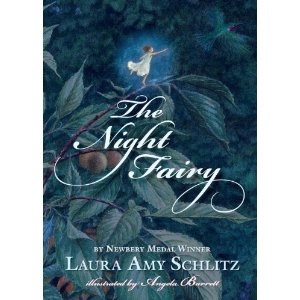
The Night Fairy / Laura Amy Schlitz and Angela Barrett (ill.)


The Night Fairy by Laura Amy Schlitz is the story of a young night fairy named Flory who lost her wings and managed to live in among animals of the woods without the confidence of being able to simply fly away to safety. Flory has to befriend a squirrel named Skuggle in order to get food and to stay safe from the dangerous creatures and the giantess that roams this part of her world. Flory hatches a plan to ride on the back of a hummingbird in order to gain some of the freedom she had when she could fly, if she could only get the attention of the bird and convince it to do something it really does not want to do.

The Night Fairy is a modern day fairy tale that tells of the struggles of Flory and her attempts to convince animals in her surroundings to help her or at least not to eat her. Flory undergoes many emotional moments as she makes some hard decisions about her predicament and the path she should follow. The Night Fairy is beautifully, but sparsely illustrated by Angela Barrett and the story is clearly enhanced by the visual clues she adds to the story.

Schlitz, Laura Amy and Angela Barrett (illustrator) (2010). The Night Fairy. Somerville, MA: Candlewick Press.

Wednesday, April 21, 2010

Skellig / David Almond


Skellig is another tale by David Almond that combines the real-life drama of a ten year old boy’s life with a mysterious creature that lives in his garage. Michael has just moved into a new house with his mother and father and his ailing infant sister. Michael sneaks into the garage that should be condemned only to find an old “man” or “creature” living behind some furniture surviving on bugs and mice and crippled to the point that he cannot move. Michael helps the cranky creature and with the help of his new friend Mina moves Skellig from the dangerous structure only to discover that the he is transforming from a crippled wisp of man into something very different.

Skellig looks at various questions that a ten year old boy might have like; how can he help his family through a painful event like having a sick baby, are there such things as angels and how would we know if we saw one. Michael also has to navigate the sea of friendships to see if he can trust new friends and if he should ignore old friends. Michael also has to sail through the waves of adults that continue to draw his attention away from his curiosity about Skellig and his love for his sister.

Almond, David (1998). Skellig. New York: Yearling Book.